
Lymphoedema Self-management
📅 October 2026 | 🕐 5 min read | ✍️ Ynone Team
Exercise and movement with lymphoedema: what you need to know
"Can I go to the gym?"
"Is swimming safe?"
"I used to run — do I have to stop?"
These are among the most common questions people ask after a lymphoedema diagnosis. And the answers, unfortunately, are often vague or contradictory — which leaves many people doing too little out of fear, or too much without guidance.
Here is what the evidence actually says.
Movement is not the enemy
Let's start with the most important point: physical activity is not something to avoid with lymphoedema. It is part of the treatment.
For years, patients were told to rest, protect the affected limb, and avoid anything strenuous. We now know this advice was wrong — and potentially harmful. Inactivity reduces lymph flow, weakens the muscles that support lymphatic drainage, and contributes to the gradual worsening of the condition.
Unlike the cardiovascular system, the lymphatic system has no central pump like the heart. However, lymph transport is not purely passive. The collecting lymphatic vessels have their own pumping mechanism, created by rhythmic contractions of the smooth muscle in their walls (lymphangiomotor activity). Muscle contractions, joint movement, breathing and external pressure additionally support lymph transport. Every time you move — walk, swim, stretch, cycle — you are actively supporting your lymphatic drainage. Movement is, in a very real sense, part of the therapy.
This does not mean all activity is equal, or that there are no considerations to keep in mind. But the starting point is this: movement helps.
What kind of exercise is most beneficial?
Not all exercise affects the lymphatic system in the same way. The most beneficial activities for lymphoedema are those that combine rhythmic muscle contractions with controlled breathing — without placing excessive load on the affected limb.
Walking
Walking is one of the most effective and accessible forms of exercise for people with lymphoedema. The alternating contraction and relaxation of the leg muscles acts as a natural pump for the lymphatic vessels. It is low impact, easy to pace, and requires no special equipment beyond a well-fitted compression garment.
Swimming and water-based exercise
Swimming and water-based exercise are particularly well-suited to lymphoedema. The gentle hydrostatic pressure of the water provides a natural form of external compression across the whole body, while the resistance of the water supports muscle activation without high impact. Many people find that swimming is one of the activities that makes their limb feel most comfortable.
Cycling
Cycling — both outdoor and stationary — offers similar benefits to walking: rhythmic lower limb movement, controlled breathing, low impact on the joints.
Yoga, Pilates and stretching
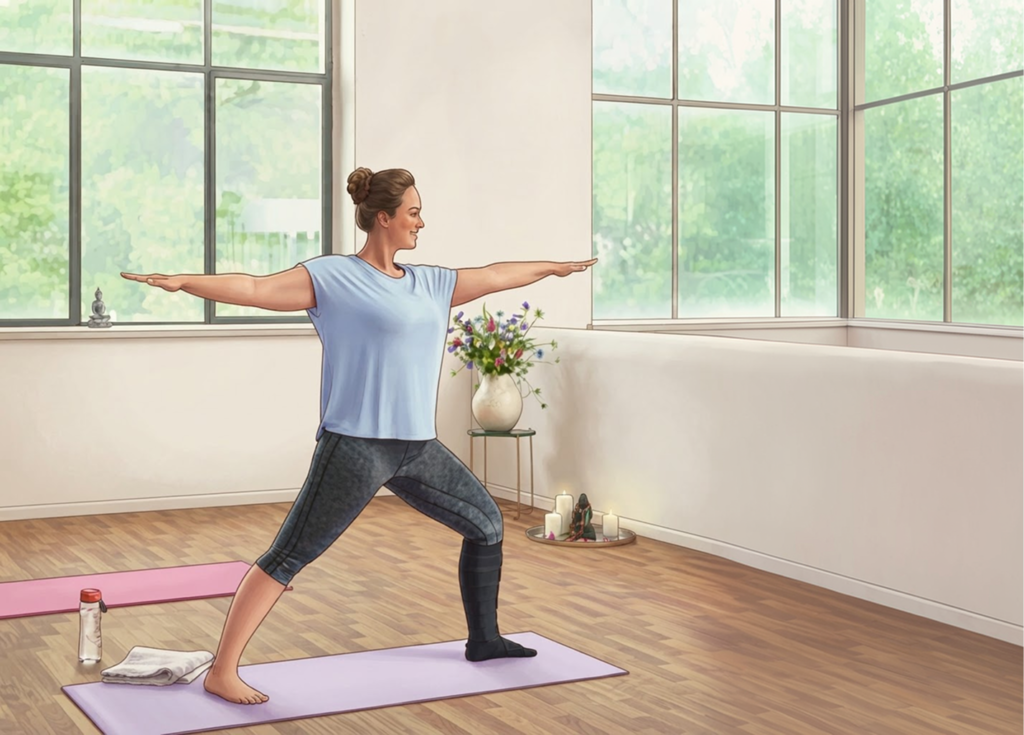
Yoga, Pilates and stretching can be excellent for lymphoedema management, particularly exercises that incorporate deep diaphragmatic breathing. Breathing movements can support lymphatic flow and can be a helpful part of an exercise or self-management routine.
Strength training
Strength training is not off-limits, but requires more care. Progressive resistance training — starting light and increasing gradually — has been shown to be safe and beneficial for many people with lymphoedema, including those with secondary lymphoedema following breast cancer treatment. The key is progression: begin with low resistance and build slowly, monitoring your limb's response.
Key takeaways
- Movement is part of lymphoedema treatment — inactivity makes the condition worse, not better.
- The lymphatic system relies on muscle contractions, breathing and movement to transport lymph fluid.
- Walking, swimming, cycling and yoga are among the most beneficial activities for lymphoedema.
- Strength training is safe when approached progressively — start light and build gradually.
- Wear your compression garment during exercise unless your therapist advises otherwise.
- Monitor your limb after activity: temporary heaviness is normal; persistent worsening is not.
- The best exercise is one you enjoy and can sustain — consistency matters more than intensity.
- Ynone helps you log your activity and track how your limb responds over time.
Sources and clinical references
This article was written using current clinical guidelines and patient research, including:
- International Society of Lymphology (ISL) — Consensus Document on the Diagnosis and Treatment of Peripheral Lymphedema, 2020
- British Lymphology Society (BLS) — Patient resources and clinical guidance
- Schmitz KH et al. — Weight lifting in women with breast cancer-related lymphoedema, NEJM, 2009
- Földiklinik / Földi College — CDT clinical principles and patient education
This article is reviewed periodically to ensure accuracy. It is intended for educational purposes only. Always consult a qualified healthcare professional for advice about your individual situation.
This article was produced with the support of AI-assisted research and writing tools, and reviewed for clinical accuracy by Henry Schulze, Clinical Advisor, Lymphoedema Therapist, Educator & Author.
Try Ynone for free
Join the App Waiting List
Be among the first to try Ynone and help shape a digital self-management tool built for people living with lymphoedema. No commitment — just early access.
Join the waiting list