About Lymphoedema
📅 October 2026 | 🕐 5 Min. read | ✍️ Ynone Team
Lymphoedema vs lipoedema: what is the difference?
Heavy legs. Swelling that doesn't improve with diet or exercise. A feeling that something is wrong, but nobody has given you a clear answer.
If this sounds familiar, you are not alone — and you are not imagining it.
Many people, most of them women, spend years with heavy, swollen legs and are simply told to lose weight before anyone looks closely at the possible causes.
These two conditions are frequently confused — even by clinicians who are not specialists in lymphology. The names sound similar. The symptoms can overlap. And for many patients, years pass before anyone distinguishes between them.
The difference matters enormously. Because lipoedema and lymphoedema are different conditions, affecting different body systems, with different causes — and they need different treatment approaches.
This guide explains what each condition is, how they differ, and what the overlap between them looks like.
What is lymphoedema?
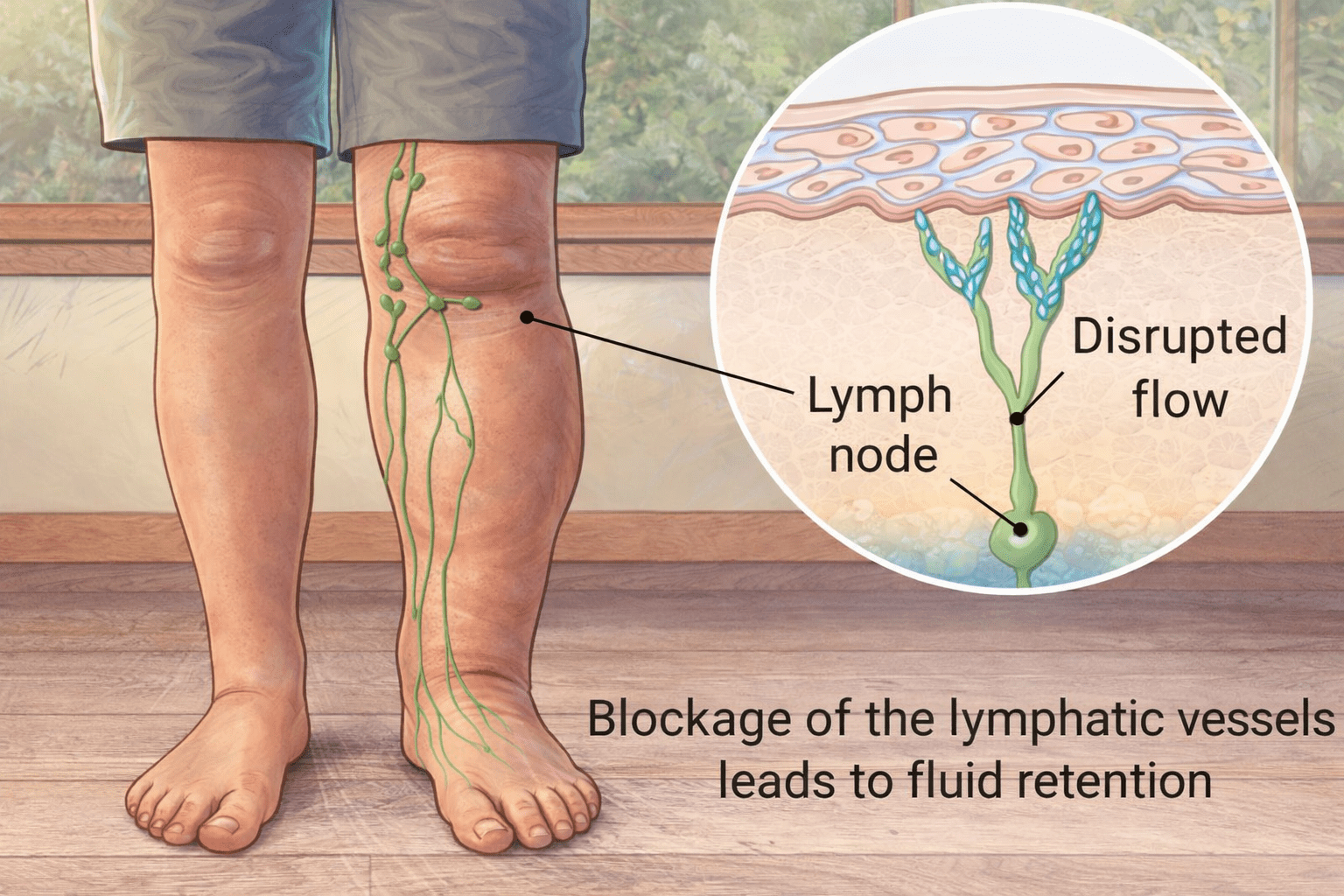
Lymphoedema is caused by a failure of the lymphatic system. When the lymphatic vessels or nodes are damaged, missing or underdeveloped, the system can no longer drain fluid efficiently from the tissue. Protein-rich fluid accumulates, causing swelling — most commonly in the arms or legs.
Lymphoedema often affects one arm or leg more than the other, and the hand or foot is frequently involved.
Lymphoedema can be primary (resulting from developmental or functional abnormalities of the lymphatic system, which may be congenital or genetic, although the swelling can become apparent at any stage of life) or secondary (caused by damage to a previously healthy system, most commonly through cancer treatment, infection or surgery).
The Stemmer sign describes the inability to lift the skin on the second toe or finger into a fold. A positive Stemmer sign can support the clinical diagnosis of lymphoedema, particularly in more established disease. However, a negative Stemmer sign does not exclude lymphoedema and should always be interpreted together with the overall clinical findings.
What is lipoedema?
Lipoedema is a fundamentally different condition. Lipoedema is primarily a disorder of adipose (fat) tissue and, unlike lymphoedema, is not defined by primary lymphatic insufficiency. Lipoedema and lymphoedema are distinct conditions and should be differentiated accordingly.
According to the German S2k Guideline on Lipoedema (2024) — the most recent authoritative clinical guideline on the condition — lipoedema is defined as a painful, disproportionate, symmetrical disorder of fat tissue distribution affecting the extremities, occurring almost exclusively in women.
Key characteristics of lipoedema include:
- Pain on touch — even gentle pressure on the affected areas is often painful or uncomfortable. This is one of the most distinguishing features.
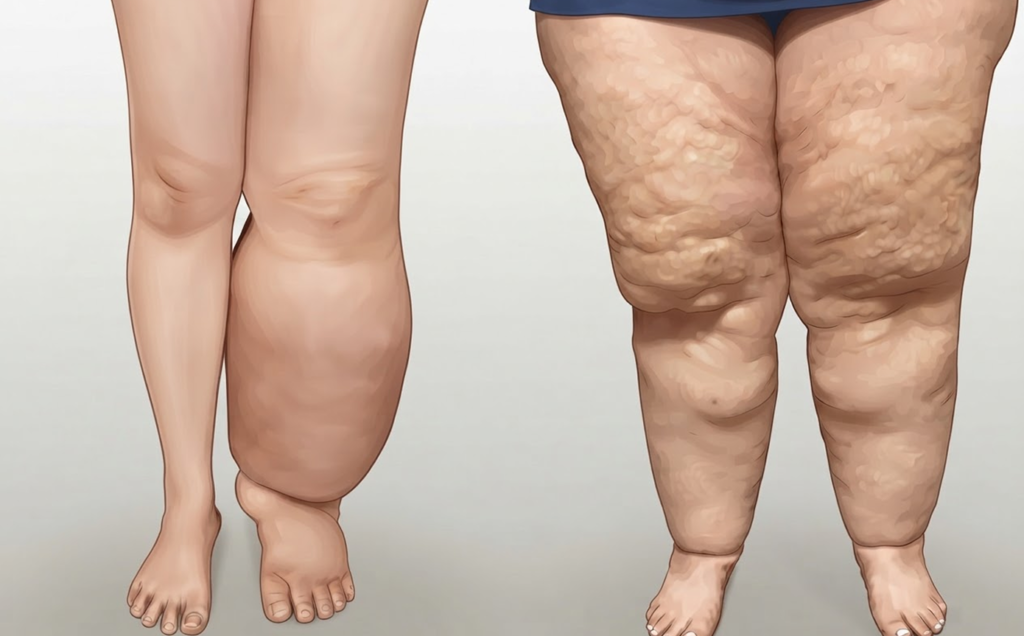
- Symmetrical distribution — both sides of the body are usually affected in a similar way, for example both legs or both upper arms.
- Disproportionate appearance — the affected limbs are clearly out of proportion with the rest of the body. The trunk, hands and feet are not affected.
- Diet alone does not resolve it — lipoedema cannot simply be "dieted away", and weight loss is not a cure for lipoedema. This is not a failure of willpower. Nutrition, physical activity and weight management still remain important parts of treatment, particularly when overweight or obesity is also present, and changes in body weight can influence limb volume and overall symptoms.
- Hormonal triggers — lipoedema typically appears or worsens during hormonal transitions: puberty, pregnancy and menopause.
- Easy bruising — easy bruising is frequently reported by people with lipoedema, but it is not specific enough to establish the diagnosis on its own.
Hands and feet are typically spared in lipoedema, which is one of the features that helps distinguish it from lymphoedema. In lipoedema alone, the Stemmer sign is usually negative, because the feet are typically spared. A negative result, however, does not rule out lymphoedema.
Side by side: the key differences
| Lymphoedema | Lipoedema | |
|---|---|---|
| Cause | Lymphatic system failure | Abnormal fat tissue distribution |
| Who it affects | Anyone | Almost exclusively women |
| Distribution | Often asymmetrical (one side worse) | Typically symmetrical |
| Feet and hands | Often involved | Typically spared |
| Pain on touch | Usually not painful, may feel heavy | Typically painful or tender |
| Easy bruising | Not characteristic | Frequently reported, not diagnostic |
| Response to diet | Weight can influence symptoms | Cannot be dieted away, but weight management still matters |
| Stemmer sign | Often positive, supports the diagnosis | Usually negative (does not exclude lymphoedema) |
| Erysipelas risk | Increased | Lower (higher if lymphoedema is also present) |
| Tissue character | Pitting oedema (early), then fibrosis | Soft, nodular fat tissue |
Why are they so often confused?
Several factors contribute to the confusion between these two conditions.
The names sound alike. Lipoedema and lymphoedema differ by only a few letters, and both involve swelling of the limbs. For patients who have not yet received a clear explanation, the distinction is not obvious.
Symptoms overlap in the early stages. Both conditions cause heaviness, swelling and visible changes to the affected limbs. Without specialist assessment, the picture is not always immediately clear.
Lipoedema is widely underdiagnosed. Lipoedema can occur together with obesity, and the two are not always told apart, although they are different conditions. Many patients spend years being told to lose weight when the correct diagnosis would have opened a completely different treatment pathway.
Both conditions can coexist. This is an important point, explained in more detail below.
When lipoedema and lymphoedema coexist
Lipoedema and lymphoedema are distinct conditions and should be considered separately. Lipoedema itself should not be regarded as a progressive stage leading inevitably to lymphoedema.
A person with lipoedema may, however, also develop lymphoedema. In this situation, lymphoedema should be assessed as an additional condition, and its underlying cause should be considered rather than automatically attributing it to lipoedema.
Obesity is an important potential contributor to secondary lymphatic dysfunction and may lead to obesity-associated lymphoedema, particularly in people with severe obesity. Other causes of secondary lymphoedema, such as previous surgery, cancer treatment, trauma or infection, should also be considered according to the individual medical history.
The coexistence of lipoedema and lymphoedema should therefore be understood as the presence of two distinct conditions, rather than as a separate disease or simply a later stage of lipoedema. Specialist input is important to assess and manage both.
How is the diagnosis made?
Neither lipoedema nor lymphoedema can be diagnosed by a standard blood test. Diagnosis is clinical — based on a thorough medical history, physical examination, and in some cases imaging.
Lymphoedema is primarily diagnosed clinically through medical history and physical examination. Imaging techniques such as lymphoscintigraphy (a form of imaging that maps lymph flow) or other lymphatic imaging methods may provide additional information when the diagnosis is uncertain or when a more detailed assessment of lymphatic function is required.
Lipoedema diagnosis is clinical. It is based on the characteristic disproportionate and usually symmetrical distribution of fat tissue, combined with symptoms such as pain or tenderness. Hands and feet are typically spared. The overall clinical picture and other possible diagnoses should be considered. The German S2k Guideline (2024) provides the most current framework for clinical assessment.
If you are not sure which condition you have — or whether you have both — a referral to a specialist in lymphology or a dedicated lymphoedema clinic is the right next step. General practitioners and physiotherapists without specific lymphology training may not have the expertise to distinguish between these conditions reliably.
Does it matter which one you have?
Yes — significantly.
The core management principles overlap: compression therapy, appropriate movement, and skin care are important in both conditions. But the specifics differ.
In lipoedema, conservative management usually combines compression for comfort and support, tailored physical activity, nutrition and weight management where relevant, and self-management. Manual lymphatic drainage may be used as part of an individual conservative treatment approach, particularly for symptom and pain management. It does not reduce the fat tissue associated with lipoedema itself. In more advanced cases or where conservative management is insufficient, surgical options — particularly liposuction performed by a specialist — may be considered.
Lymphoedema management is based on a multimodal approach. Depending on the individual clinical situation, this may include compression therapy, manual lymphatic drainage, exercise, skin care, education and structured self-management. The importance and intensity of each component should be adapted to the individual patient and treatment goals.
When both conditions coexist, the management plan needs to address both — which requires a clinician who understands each.
If you are still searching for answers
If you have been living with swelling, pain or unexplained changes to your limbs and have not yet received a clear diagnosis, keep asking questions. These conditions are underdiagnosed, and the path to the right answer sometimes requires persistence.
Ask your doctor specifically about lipoedema and lymphoedema. Ask for a referral to a lymphology specialist or a clinic with expertise in both conditions. And bring as much information as you can to your appointments — the pattern of your symptoms, when they started, how they have changed, what makes them better or worse.
You deserve a clear answer. And clear answers do exist — they just sometimes require finding the right specialist.
Ynone helps you build and track exactly the kind of structured symptom and measurement record that makes specialist appointments more productive — whatever condition you are managing.
Key takeaways
- Lymphoedema is caused by lymphatic system failure; lipoedema is a disorder of fat tissue distribution — they are distinct conditions.
- Lipoedema affects almost exclusively women and is typically symmetrical, painful on touch, and spares the hands and feet.
- Lymphoedema often affects one side more than the other, frequently involves the hand or foot, and is usually not painful to touch.
- Both conditions can coexist — but this should be understood as two separate diagnoses, not one condition progressing into the other.
- Neither can be diagnosed by a blood test — diagnosis is clinical and may require specialist assessment.
- The right treatment depends on the correct diagnosis: management differs meaningfully between the two conditions.
- If you have not received a clear answer, ask specifically for a referral to a lymphology specialist.
- Tracking your symptoms, measurements and history with Ynone helps you arrive at specialist appointments fully prepared.
Sources and clinical references
This article was written using current clinical guidelines and patient research, including:
- German S2k Guideline on Lipoedema (2024)
- Cleveland Clinic Journal of Medicine (July 2024)
- ILF Best Practice Guidelines — International Lymphoedema Framework
- International Society of Lymphology (ISL) — Consensus Document on the Diagnosis and Treatment of Peripheral Lymphedema, 2020
This article is reviewed periodically to ensure accuracy. It is intended for educational purposes only. Always consult a qualified healthcare professional for advice about your individual situation.
This article was produced with the support of AI-assisted research and writing tools, and reviewed for clinical accuracy by Henry Schulze, Clinical Advisor, Lymphoedema Therapist, Educator & Author.
Try Ynone for free
Join the App Waiting List
Be among the first to try Ynone and help shape a digital self-management tool built for people living with lymphoedema. No commitment — just early access.
Join the waiting list