
Compression & care
📅 October 2026 | 🕐 5 Min. Read | ✍️ Ynone Team
How to choose and wear compression stockings: a practical guide
The stocking falls down by noon. You're not sure how many hours you're supposed to wear it. You've been told to wash it, but nobody explained how often. And you're honestly not sure if you're even wearing the right size.
If any of this sounds familiar, you are not alone. Compression therapy is one of the most important parts of lymphoedema management — and one of the least well explained to patients.
This guide answers the questions that come up most often.
Why compression matters
When the lymphatic system cannot drain fluid efficiently on its own, it needs external support. That is exactly what a compression garment provides.
The gentle, consistent pressure of a compression stocking or sleeve does two things. First, it reduces the space available for fluid to accumulate in the tissue. Second, it supports the walls of the lymphatic vessels, helping them move lymph more effectively — especially during movement and exercise.
Wearing compression is not about fixing the problem. It is about managing it consistently, every day, so that the swelling stays controlled and the tissue does not deteriorate over time.
For many people with lymphoedema, compression is a central part of their daily self-management routine, alongside movement, skin care and, where prescribed, manual lymphatic drainage.
Choosing the right garment
Compression garments are available in different compression classes, materials and constructions. The appropriate garment should be selected individually, taking into account the location and severity of the lymphoedema, tissue characteristics, limb shape, your individual measurements and your everyday needs.
Your garment should always be prescribed and measured by a qualified professional. This is not something to guess or buy off the shelf. An ill-fitting garment — too tight in the wrong place, or not tight enough overall — can be uncomfortable at best and counterproductive at worst.
That said, here are the basic things worth understanding:
Compression classes refer to the level of pressure the garment applies, measured in mmHg. The appropriate class is determined individually by your therapist or doctor, based on your clinical findings.
Flat-knit vs round-knit. Flat-knit garments are made on a flat loom and have a seam. They are stiffer and hold their shape better. Flat-knit garments are frequently used in lymphoedema management, particularly where greater stiffness, containment or adaptation to an irregular limb shape is required. Round-knit garments are seamless and more elastic. The choice between flat-knit and round-knit should be based on your individual clinical requirements rather than diagnosis or stage alone.
Custom vs standard. Standard (off-the-shelf) garments are made to fixed size ranges. Custom garments are made to your exact measurements. If your limb has an unusual shape, significant asymmetry, or does not fit standard sizing well, a custom garment is worth discussing with your therapist.
How to put it on — and why it matters
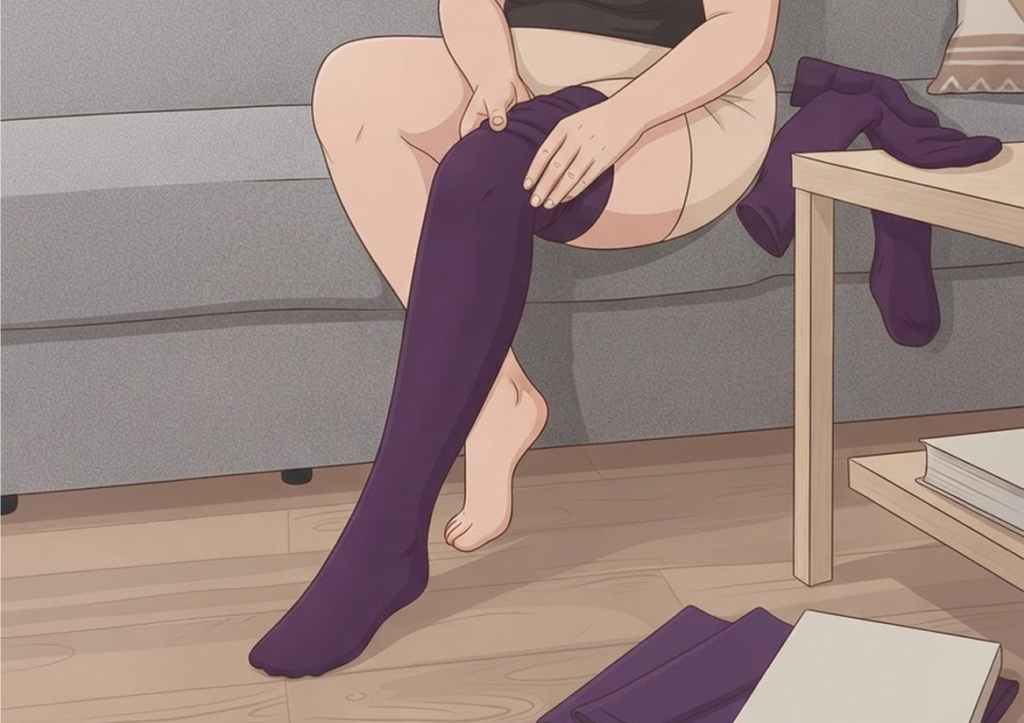
Putting on a compression stocking properly takes practice. Many people find it genuinely difficult at first — especially first thing in the morning when motivation is low and fingers are not yet fully awake.
A few things that help:
- Put it on first thing in the morning, before you get up or within the first few minutes of waking. This is when your limb is at its smallest, before gravity and daily activity allow fluid to accumulate.
- Use a donning aid. Several tools exist to help slide the garment on smoothly — rubber gloves to improve grip, frame-style aids that hold the stocking open while you step in, or silk liner gloves to reduce friction. Ask your therapist which type suits your garment.
- Work slowly from the foot upward. Don't bunch the garment at the ankle and pull up — distribute it evenly as you go, smoothing out any wrinkles. Wrinkles concentrate pressure and can be uncomfortable or harmful.
- Check the fit. The garment should feel firm and supportive — not painfully tight, not loose enough to roll or bunch. If it is sliding down during the day, it may be the wrong size, the wrong style, or simply worn out.
How long to wear it
Wearing time is individual. How long a compression garment should be worn depends on your clinical situation, your treatment goals and the type of garment. Many people with lymphoedema wear compression for much of the day, particularly during upright activity — but wearing time should be adapted to you and discussed with your treating healthcare professional.
You do not need to wear it at night, unless your therapist has specifically advised otherwise — for example, during an intensive decongestion phase with bandaging.
There are times when you can take it off during the day — to shower, to swim (though some patients swim with it on), or briefly for skin care. Your therapist can tell you what applies in your situation.
How to wash and care for it
Washing your garment daily is important — not just for hygiene, but because it restores the elasticity of the fabric after a day of wear.
- Hand wash or machine wash on a gentle cycle at 30–40°C, using a mild detergent without fabric softener. Fabric softener degrades the elastic fibres.
- Do not tumble dry. Air dry flat or over a rail — never in direct sunlight or near a radiator, as heat damages the elastic.
- Do not wring or twist the garment — press out excess water gently.
This is why most patients benefit from having two garments — one to wear, one to wash and dry.
When to replace it
Compression garments lose their effectiveness over time, even with careful washing and storage. The elastic fibres stretch and the compression class gradually reduces.
As a general guide, replace your garment every 3–6 months with daily use. Your therapist or prescribing doctor can advise on the right interval for your garment and your situation.
Signs that a garment needs replacing: it feels looser than it used to, it slides down more easily, or the fabric looks stretched and thin. Do not wait until it has completely stopped working before getting a new one.
If it is not working for you
A compression garment that is consistently uncomfortable, that you avoid wearing, or that you can never get on in the morning is not serving its purpose — no matter how clinically appropriate it might be on paper.
If you are struggling, talk to your therapist. There are many different garment types, fabrics, colours and donning aids available. Finding the right combination for your body, your lifestyle and your daily routine is part of the process — and it is worth getting right.
Compression therapy works when it is worn. That means the most effective garment is the one you actually put on every day.
You can find more guidance on building your daily therapy routine in our article on lymphoedema and daily life, or read about exercise and movement with lymphoedema.
Key takeaways
- Compression garments work by reducing the space for fluid to accumulate and supporting lymphatic vessel function — they are a daily management tool, not a cure.
- Your garment should always be prescribed and measured by a qualified professional. Do not buy off the shelf.
- Put it on first thing in the morning, before getting out of bed, when the limb is at its smallest.
- Donning aids — rubber gloves, frame aids, silk liner gloves — can make the process significantly easier.
- Wash your garment daily at 30–40°C without fabric softener, and air dry it. This preserves elasticity.
- Replace your garment every 3–6 months with daily use — don't wait until it has stopped working.
- If the garment is consistently uncomfortable or you avoid wearing it, talk to your therapist. There are many options.
- The most effective garment is the one you actually wear every day.
Sources and clinical references
This article was written using current clinical guidelines and patient research, including:
- International Society of Lymphology (ISL) — Consensus Document on the Diagnosis and Treatment of Peripheral Lymphedema, 2020
- British Lymphology Society (BLS) — Compression hosiery guidance
- ILF Best Practice Guidelines — International Lymphoedema Framework
- Földiklinik / Földi College — CDT clinical principles and patient education
This article is reviewed periodically to ensure accuracy. It is intended for educational purposes only. Always consult a qualified healthcare professional for advice about your individual situation.
This article was produced with the support of AI-assisted research and writing tools, and reviewed for clinical accuracy by Henry Schulze, Clinical Advisor, Lymphoedema Therapist, Educator & Author.
Try Ynone for free
Never forget your compression routine again
Ynone tracks your daily compression wear, reminds you when to renew your garment, and keeps your therapy data in one place — so you can focus on living your life.
Join the waiting list