
Living with lymphoedema
📅 August 2026 | 🕐 5 Min. Lesezeit | ✍️ Ynone Team
How to prepare for your lymphoedema appointment
Why preparation matters
Six months. Sometimes longer. That is often how much time passes between appointments with a lymphoedema specialist or physiotherapist. A lot happens in those months — good days and difficult ones, changes in swelling, a new garment, a missed week of drainage, a bout of erysipelas.
And then the appointment arrives, and when the doctor asks "how have you been?", it is surprisingly hard to answer clearly.
A well-prepared appointment is not just more efficient. It is genuinely better for your care. Your doctor or therapist makes decisions based on what you tell them and what they observe. If you arrive without a clear picture of the past weeks or months, important information gets missed. Changes that happened gradually are harder to recall. Questions you meant to ask get forgotten in the moment.
The gap between lymphoedema appointments is long. What happens in that gap — your daily routine, your symptoms, your struggles, your progress — is the most important information your care team needs. Bringing it clearly and concisely to your appointment transforms what is possible in that room.
The most common regret after a lymphoedema appointment
In patient communities, one theme comes up again and again: "I forgot to ask about..." or "I didn't mention that it had been worse for three weeks." Furthermore, many patients feel they do not want to take up too much time, or they are not sure whether something is worth mentioning. Consequently, important information never gets shared — and the appointment ends without the answers that were needed.
Before the appointment: what to gather
You do not need to prepare a lengthy report. A few structured notes, gathered over the weeks before your visit, are enough to make a significant difference.
Your measurements
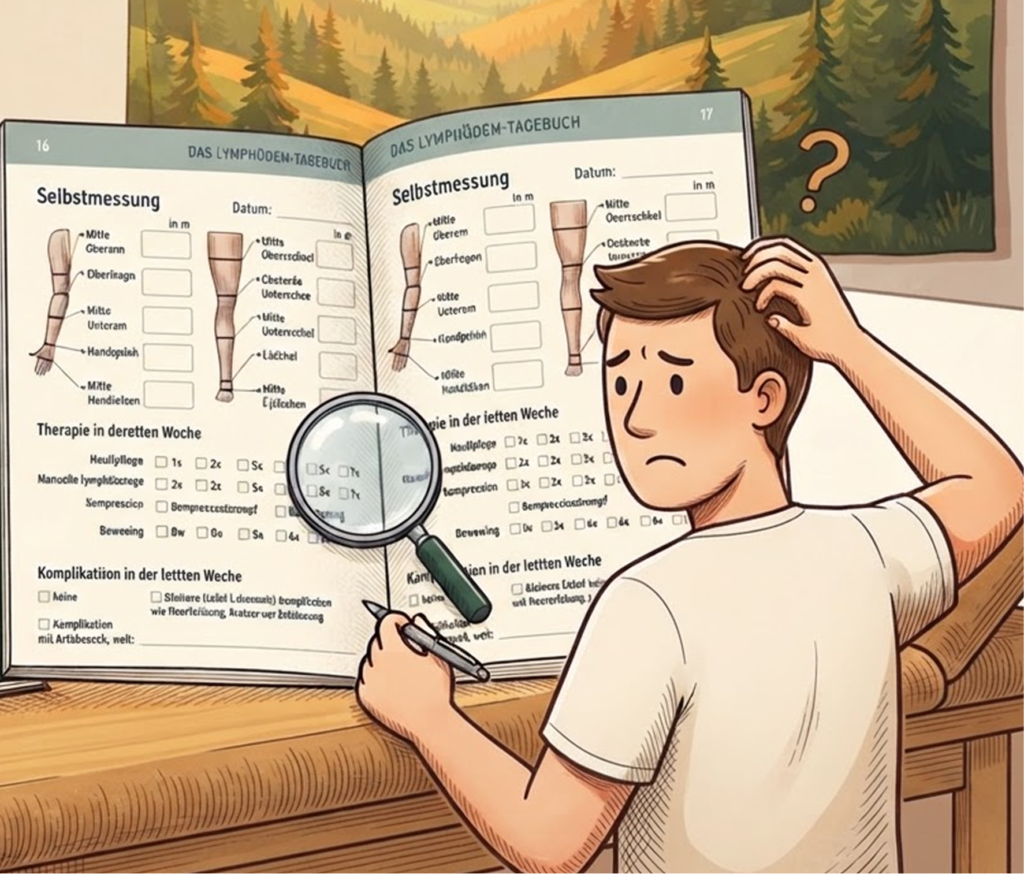
If you have been tracking the size of your affected limb, bring those records. Even a simple list of weekly measurements — taken at the same point and the same time of day — gives your therapist a clear view of how your swelling has behaved over time. If measurements have been stable, that is valuable information. If there has been a gradual increase, that is equally important to know.
Your therapy routine
How consistently have you been wearing your compression garment? How often have you done drainage — with your therapist, or self-drainage at home? Have there been periods when the routine broke down, and why? This is not about self-judgement. Furthermore, your therapist needs this information to understand what has actually been happening — not just the ideal version of your routine.
Symptoms and changes
Has the swelling changed — in size, in texture, in which part of the limb is affected? Have you had any skin infections, redness or fever? Have you noticed new symptoms — pain, heaviness, tightness at different times of day? Moreover, have there been triggers that made things worse — heat, travel, a period of inactivity?
Your compression garment
When was your current garment fitted? Has it started to feel looser or less effective? Are there any problems with it — discomfort, rolling, skin reactions? Garments typically need renewing every three to six months, and a garment that has lost its effectiveness is one of the most common and easily missed reasons for increased swelling.
Medications and other health changes
Have you started any new medications since your last appointment? Have you had surgery, an infection, or a significant change in weight? These can all affect lymphoedema, and your care team needs to know about them.
Your questions for the appointment
Writing down your questions before the appointment is one of the most effective things you can do. Additionally, it is worth prioritising — put the most important question first, in case time runs short.
Some questions that patients frequently wish they had asked:
- Is my current compression garment still the right one for me, or should we review it?
- Are there signs of progression I should be aware of?
- Should I be doing anything differently with my self-drainage technique?
- What should I do if I notice signs of infection?
- Are there any activities I should add or avoid?
- When should I come back, and what should I monitor between now and then?
Questions about your garment
If you have concerns about your compression garment — fit, comfort, effectiveness — this is the moment to raise them. Garment issues are extremely common, and a poorly fitting garment can significantly undermine your management. Consequently, do not leave the appointment without a clear answer on whether it needs to be reviewed.
On the day
A few practical points that make the appointment itself more effective:
- Wear your compression garment — your therapist will want to assess how it fits and how it is performing.
- Take your notes with you — even a short list on your phone is better than trying to remember everything in the moment.
- Mention everything — even things that seem minor. Your therapist would rather know about a small change than miss something that matters.
- Ask for clarification — if something is explained in a way you do not fully understand, ask for it to be explained differently. Furthermore, you are entitled to leave the appointment with a clear understanding of what to do next.
If you feel the appointment is too short
Many patients feel that appointments are not long enough to cover everything. If this is a recurring problem, it is worth raising directly — asking whether a longer appointment is possible, or whether some questions can be addressed by email or phone. Moreover, the better prepared you are, the more you can cover in the time available.
After the appointment
After your appointment, take a few minutes to note down what was discussed and what was recommended. Memory fades quickly, and a lymphoedema appointment often involves a lot of information.
Write down:
- Any changes to your routine that were recommended
- Any new information about your condition
- What to monitor before the next appointment
- When the next appointment is, and what to bring
Deshalb ist es wichtig — as German-speaking patients often say — to treat this as the beginning of the next cycle, not just the end of today's visit. The notes you take now will become the preparation for your next appointment.
How Ynone helps you prepare
Ynone is a lymphoedema self-management platform designed specifically to support the gap between clinical appointments — so that when your appointment arrives, you have everything you need.
With Ynone, you can:
- Track your daily therapy routine — compression, drainage, exercise, skin care
- Record your limb measurements regularly and see changes over time
- Log symptoms, triggers and changes as they happen — not just when you try to remember them weeks later
- Set reminders for compression garment renewals
- Prepare a clear summary of your therapy data to share with your care team
Furthermore, you can read more about what lymphoedema is and how it progresses on our What is Lymphoedema page, or find answers to common questions in our Ynone Blog.
Ynone is an educational and self-management support tool. It does not diagnose lymphoedema and does not replace your healthcare team.
Key takeaways
- The gap between lymphoedema appointments is long — what happens in that gap is the most important information your care team needs.
- Prepare your measurements, therapy routine, symptoms and questions before each appointment.
- Write your questions down and prioritise — put the most important one first.
- Mention everything, even things that seem minor — your therapist needs the full picture.
- After the appointment, note down what was discussed and what to monitor next.
- Ynone helps you track everything between appointments — so you arrive prepared every time.
Sources and clinical references
This article was written using current clinical guidelines and patient research, including:
- International Society of Lymphology (ISL) — Consensus Document on the Diagnosis and Treatment of Peripheral Lymphedema, 2020
- British Lymphology Society (BLS) — Patient resources and clinical guidance
- Lymphoedema Support Network (LSN) — HealthUnlocked patient community insights
- Földiklinik / Földi College — CDT clinical principles and patient education
This article is reviewed periodically to ensure accuracy. It is intended for educational purposes only. Always consult a qualified healthcare professional for advice about your individual situation.
This article was produced with the support of AI-assisted research and writing tools, and reviewed for clinical accuracy by Margarete Baum, Lifecoach - Mother and caregiver of Lymphoedema patient.´
Try Ynone for free
Join the App Waiting List
Be among the first to try Ynone and help shape a digital self-management tool built for people living with lymphoedema. No commitment — just early access.
Join the waiting list